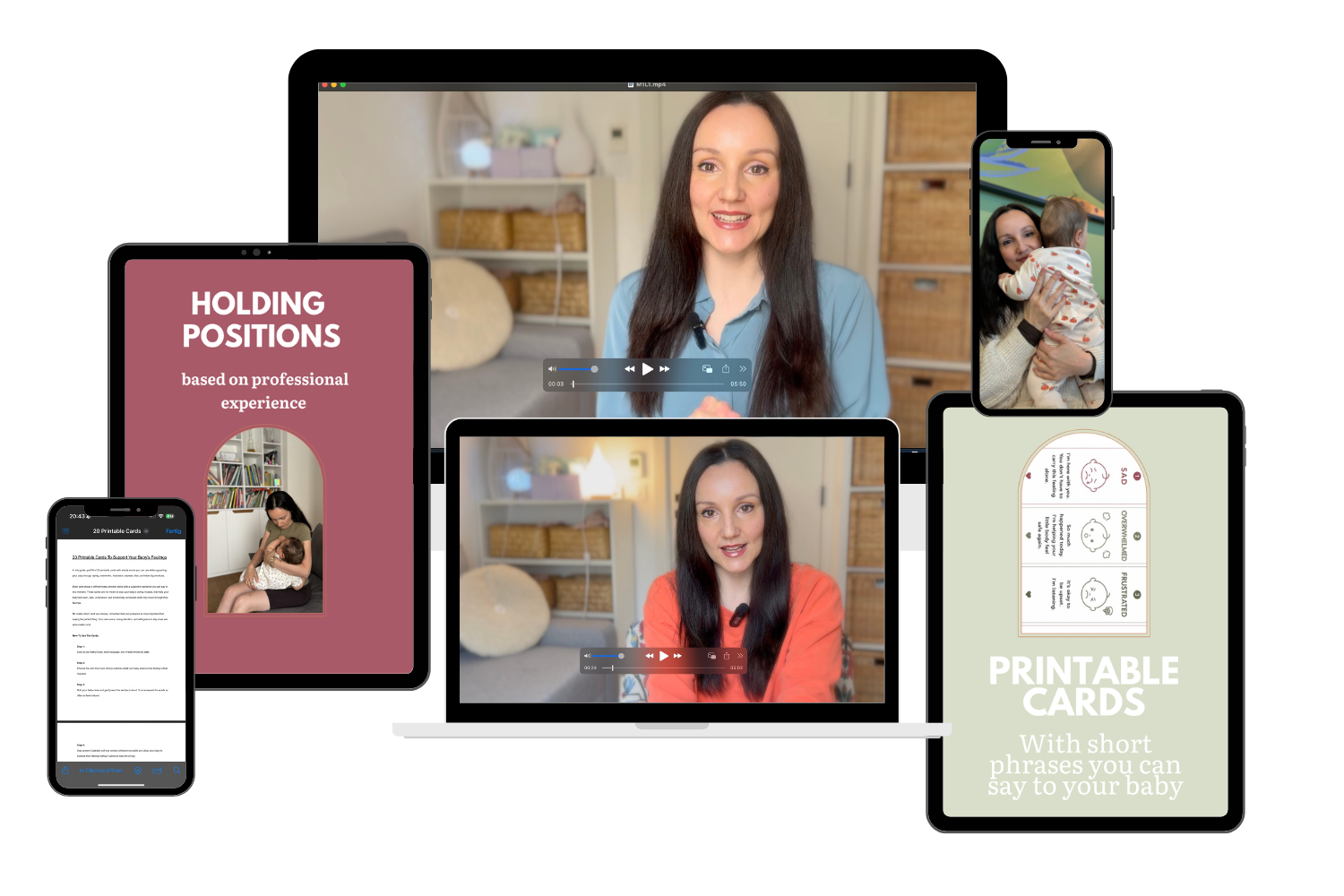
How exactly can this course help me and my baby?
Many parents notice that their baby becomes physically more relaxed, calmer during the day, more settled in the stroller, carrier, or car seat, and sometimes even sleeps more deeply over time.
Some parents also feel feeding becomes easier, their baby seems less tense, and emotional connection becomes much stronger after crying support.
But one of the biggest changes often happens inside the parent:
crying feels less frightening, parents feel calmer, more confident, and less helpless during difficult moments.
This course is about safe co-regulation, emotional presence, and helping both baby and parent feel more settled step by step.
How long does this course take a watch?
Approximately 1 to 1.5 hours from start to finish. I designed it to feel like a real session with me as a psychotherapist — so you can go through it in one or two sittings, in a calm and manageable way.
My baby is older then 1 Year, will this work?
Yes — the principles still apply. Emotional release, co-regulation, and staying present with your child’s feelings remain important beyond the baby stage. However, older babies and toddlers express emotions differently, and the process may look a bit different. This course is designed especially for 0–6 month but you can still take the core ideas and gently adapt them to your child’s age and needs.
Is this safe for my baby?
Yes. Your baby is never left alone or ignored. You stay present, responsive, and connected the entire time. In the course, you will learn to always check your baby’s physical needs first — like hunger, discomfort, illness — before supporting the crying. This is about safe emotional support, guided by awareness and your intuition — not pushing your baby beyond what feels right.
Is this suitable for colic?
No, if your baby truly has colic, then of course you should respond accordingly and try to relieve the pain and discomfort.
However, I personally believe that colic is sometimes diagnosed very quickly, and in some cases it may be worth considering whether the crying could also be related to overstimulation, nervous system overwhelm, or emotional distresss instead of only physical pain. In this course I talk about how to know if it´s colic or emotional distress.
Is this suitable for neurodiverse babies like Autism or ADHD?
Yes, absolutely. Babies cannot be reliably diagnosed with autism or ADHD. If you're worried because of family history or certain signs you're noticing, there is no need to panic.
In fact, this course may be especially helpful for more sensitive or neurodivergent children. Many of these children experience emotions and sensory input more intensely and often need even more understanding, connection, and emotional support.
Is this course only for babies who cry a lot?
This course is especially designed for mothers who feel overwhelmed and don’t know what to do anymore with very sensitive, emotional, or constantly crying babies.
But that does not mean calmer babies do not have feelings too. In fact, it can be very valuable for every child to have the opportunity from the very beginning to safely express emotions and “tell their story” in a loving and emotionally safe environment.
Is this course meant for mothers with birth trauma or postpartum depression?
This course is not a replacement for psychotherapy, trauma therapy, medical care, or professional postpartum support.
As a psychotherapist, I believe mothers experiencing postpartum depression, severe anxiety, birth trauma, or emotional crisis deserve direct professional and personal support.
However, this course may still feel supportive for some mothers during difficult crying phases because it focuses on emotional understanding, nervous system regulation, calm co-regulation, and reducing panic around baby crying.
The intention is not to treat mental illness, but to help parents feel less helpless, more emotionally connected, and more confident while supporting their baby safely and calmly.
Will this course help me and my baby 100%?
I can honestly say that this approach helped me personally and also helped many other parents feel calmer, more connected, and less helpless during difficult crying phases.
There are also some wonderful books and perspectives on emotional development, crying, and nervous system regulation that I can recommend if you would like to learn more before trying this approach.
But as a psychotherapist, I also want to be honest: there is no treatment, method, or approach in the world that helps every single person in exactly the same way.
Every mother, every baby, every nervous system, and every healing journey is different. This course is meant to offer support, understanding, and gentle tools — not a guaranteed outcome.
What if my baby’s crying is caused by a medical issue?
Persistent or unusual crying should always be medically evaluated first.
This course is not designed to diagnose or treat medical conditions and should never replace professional medical care.
Parents are encouraged to seek support from pediatricians, midwives, or other qualified professionals whenever something feels wrong.
This course is only intended as supportive emotional education for parents after physical and medical causes have been appropriately considered.
Isn’t it wrong to let a baby cry instead of calming them immediately?
This course is not about ignoring babies or refusing to comfort them. In fact, the entire approach is based on emotional presence, closeness, eye contact, body contact, and calm co-regulation.
Many parents hear the word “crying” and immediately think of abandonment or “cry it out.” But there is a big difference between leaving a baby alone with overwhelming feelings and staying lovingly present while supporting them through distress.
Of course babies should be comforted. But comfort is not always about instantly stopping every tear. Sometimes comfort can also mean:
“I’m here. You are safe. I’m listening. You don’t have to go through this alone.” The result is a longer calming and happy baby.
Is this just cry-it-out alone?
No. You’re not leaving your baby alone or ignoring their needs. You stay present, responsive, and emotionally connected while your baby expresses what is already there. There is a big difference between supporting your baby through their feelings and leaving them alone in distress.
And just to clarify: this is not “cry it out.”
In my course, parents learn how to stay with their baby, listen, and emotionally support them for just a few minutes, because even that alone can sometimes help a baby feel much calmer afterward.
And if a baby needs a longer emotional release, I would only ever recommend doing that with direct professional support and guidance.
This course is educational only and does not replace medical advice, pediatric care, psychotherapy, or emergency support.
Who created this course?
My name is Stefanela Čiča, and I am a psychotherapist, psychoanalyst, and mother of three.
I completed my Master’s degree in Psychotherapy Science at Sigmund Freud University in Vienna and finished my psychoanalytic training as well.
Since 2019, I have been working in private practice as a psychotherapist. I have also worked with autistic children as a school support specialist and have therapeutically supported both children and adults struggling with anxiety, panic attacks, and phobias.
This course was created not only from professional experience, but also from my own personal journey as an overwhelmed mother with a constantly crying sensitive baby after a difficult birth.